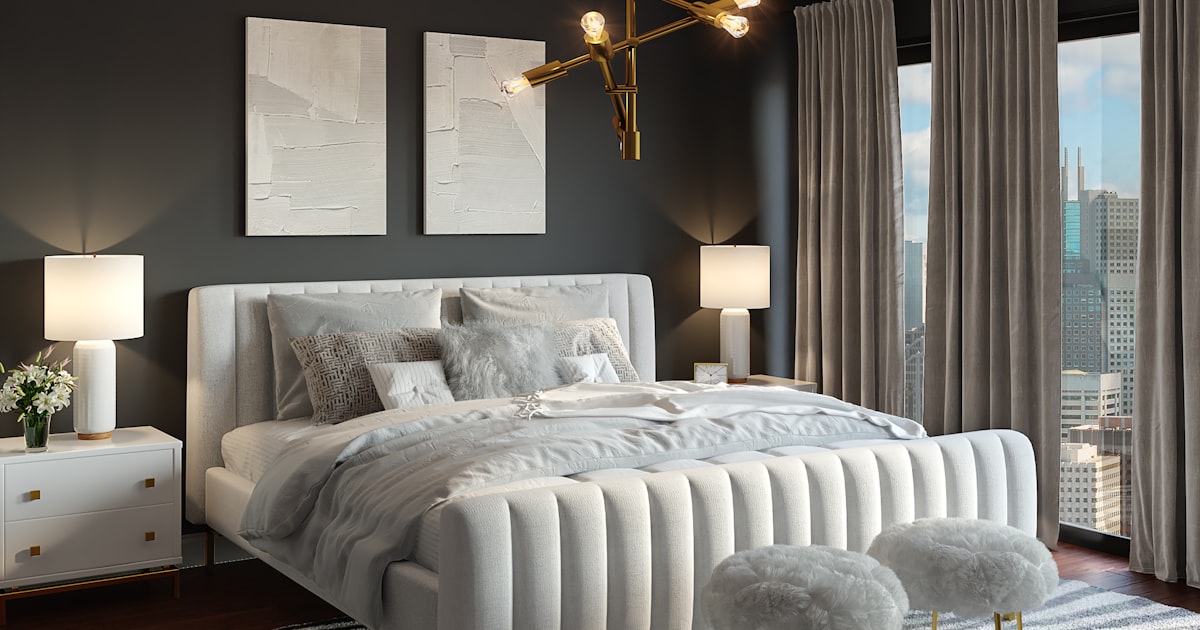
A feng shui bedroom for couples needs equal access to both sides of the bed, matching nightstands, and a layout where neither person is pushed against a wall. That covers the room. The harder question is what to do when the two of you calculate different Kua numbers and end up with opposite best sleeping directions, which happens more often than not.
Here is a question most articles on this topic never ask. Whose side of the room is it? Look at your bedroom right now. Does one side have a nightstand and a lamp while the other has neither. That imbalance shows up in the relationship whether or not either of you could explain why.
The wall test
Start here. Is either side of the bed pushed against a wall? If one person has to climb over the other to get in or out, that is not just inconvenient. Both partners need their own side, their own nightstand, their own lamp, their own space for a glass of water and a book. This is about physical equality in the room where you are most exposed, not furniture symmetry for its own sake.
Pairs, not singles
Everything in a shared bedroom reads better in twos. Two nightstands, two lamps. A single chair in the corner either gets a partner or gets swapped for something built for two. A room full of single objects reads as one person's space that someone else also sleeps in, even when two people genuinely live there. You do not need to match everything exactly, just avoid a room that visibly leans toward one person.
What to remove
Family photos do not belong in a couple's bedroom. This is the one that surprises people. The bedroom is the one room reserved for the two of you, and photos of parents, kids or extended family quietly invite other people into it. Move them to the living room or hallway.
Work items do the same thing in a different direction. A laptop or a stack of project folders on a nightstand keeps the room tied to obligations instead of rest. If you work from the bedroom, close the laptop and put it away at night, or cover the desk with a cloth.
A television in a shared bedroom becomes the room's focal point, which pulls attention toward a screen instead of toward each other. If you keep one, closing it behind cabinet doors when it is off helps more than it sounds like it should.
Anything carrying an old relationship, whether that is a gift, a photo, or furniture a previous partner chose, has no real place in a room the two of you are building together now.
Colors that work for two people
Earth tones as a base, warm beige, sand, cream, with touches of pink, peach or soft rose layered on top read as both grounded and warm. An all white bedroom feels clean but can read cold for a room meant to feel intimate, so add warmth through bedding or a rug rather than the walls themselves. Red is the one to use sparingly. It raises heart rate and can disrupt sleep at wall scale, so a couple of small accents, a candle, a book on the nightstand, carries the intent without turning the room into a stimulant.
What to do when your best direction is your partner's worst
This is the part a room rearrangement cannot solve, because it depends on two separate birth dates rather than the furniture. Each of you has a personal Kua number, calculated from your exact birth date and gender, and each number carries its own set of four favorable directions. Two people almost never share a Kua number, since it depends on both birth year and gender, and it is entirely normal for one partner's best direction to be the other partner's worst.
Get both of your numbers correctly. The calculation depends on the exact date, not just the year, because the Chinese solar year turns over on February 4 rather than January 1. Someone born in the first weeks of January calculates against the previous year, and getting this wrong flips someone's entire set of directions. The Kua number calculator applies that cutoff for each of you and returns your full set of four directions in a few seconds.
Once you have both sets, look for overlap. If either of you shares even one favorable direction with the other's set, sleep facing that one. If there is genuinely no overlap between the two of you, which does happen, prioritize whichever partner has more trouble sleeping or a real health reason to need their direction more, and let the other person apply their own favorable direction somewhere else in the home, most naturally at a desk or a reading chair rather than the bed.
None of this outranks the basics of the room. Equal space on both sides of the bed and a solid wall behind the headboard matter more to how the relationship experiences the room than which exact compass direction either of you faces. A couple with a fair, balanced room and a merely decent direction will do better than a couple with a perfect direction and a lopsided room.
The corner in your own bedroom
Stand in your bedroom doorway and look at the far corner to your right as you face in. In the Black Hat tradition this is treated as the room's relationship corner, and it is worth a look regardless of whether you find that tradition convincing, because it is a common spot for storage and clutter to quietly accumulate. If it is empty or being used to dump things, that is worth fixing on its own merits.
A pair of candles, artwork depicting two figures, or a plant with soft rounded leaves are traditional choices for that spot. This is a self-directed exercise using your own knowledge of your own room, not a claim we can make about your home from the outside. Only you know where your bedroom door actually is.
The conversation this usually starts
What actually happens once one person in a couple reads something like this is that they walk back into the bedroom with fresh eyes. They notice their partner's nightstand is smaller, or the room reads entirely in one person's taste, or the bed has sat against the wall for three years because nobody ever suggested moving it.
This is not really about furniture. It is about whether the room works equally for both people. If the honest answer is no, or "we never thought about it," that is a conversation worth having before the furniture.
Frequently asked questions
What is the best feng shui layout for a couples bedroom?
Equal space on both sides of the bed, with the bed in the command position and neither side pushed against a wall. Each partner should have their own nightstand and lamp, and the room should read as belonging to both people rather than one.
My partner and I have opposite Kua directions. What do we actually do?
Calculate both of your Kua numbers from your exact birth dates and check for any overlap between your two sets of four favorable directions. If one exists, use it. If none exists, prioritize whichever of you sleeps worse or has more reason to need the direction, and let the other person use their direction elsewhere in the home.
Should couples have matching nightstands?
They help, and they do not need to be identical, just similar in size and visual weight, each with its own lamp. The point is that the room reads as equally shared rather than skewed toward one person.
Is it bad to keep family photos in the bedroom?
The traditional view holds that the bedroom is reserved for the couple, and family photos quietly bring other people into that space. Moving them to a living room or hallway is a low effort change either way.
Does the corner exercise require you to know our floor plan?
No. It is something you do standing in your own bedroom doorway, using your own knowledge of your own room. It is not a claim about your home made from the outside, since nobody but you has that floor plan.
Does any of this help a relationship that is genuinely struggling?
Feng shui is not a substitute for a real conversation, but an unequal or cluttered room does add background friction that compounds over time. Fixing the physical imbalance removes one layer of tension and makes the room itself feel like shared, equal territory again.