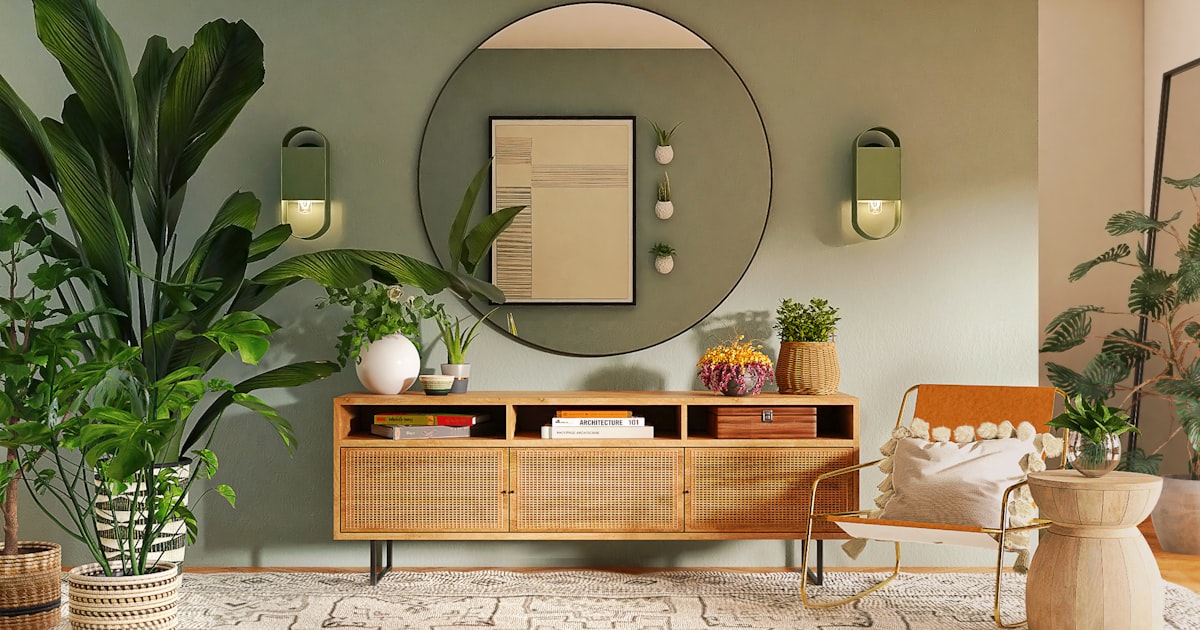
The honest answer sits between two extremes. There is no evidence for wealth-attracting crystals or compass prescriptions that ten different practitioners would disagree on. There is real evidence that command position style arrangements, decluttering and natural light measurably affect sleep, stress and focus. The practical version of feng shui works because it lines up with how your nervous system already responds to space.
Primary Keyword: does feng shui work
Meta Description: Does feng shui actually work, or is it pseudoscience? Here is an honest look at the evidence, the psychology, and what practical feng shui can and cannot do.
You have probably seen two types of feng shui content online. The first tells you to buy crystals and hang wind chimes to attract wealth. The second dismisses the entire thing as superstition. Neither is particularly helpful. So let us look at what feng shui actually does, what the evidence says, and where the line is between useful and nonsense.
Two Versions of Feng Shui
There is traditional feng shui, which involves compass readings, flying star calculations, and complex metaphysical systems that date back thousands of years. And there is practical feng shui, which focuses on how the arrangement of physical spaces affects how you feel, sleep, focus, and behave. This article is about the second version. Not because the first version is wrong, but because the second version is the one you can test for yourself tonight.
The distinction matters because it changes how you think about the whole thing. You do not have to believe in chi or energy flow to benefit from practical feng shui. You just have to arrange your space in ways that match how your nervous system actually works. Practical feng shui is not about supernatural forces. It is about environmental psychology applied to your home.
Where Feng Shui And Plain Observation Agree
Set the tradition aside for a moment and watch what people actually do. In a busy restaurant the tables against the wall fill up before the ones stranded in the middle, and nobody had to be taught to prefer them. People are harder to settle in a room where the door is behind them. A room with things on every surface is more tiring to sit in than the same room cleared. A room with one small window is a gloomier place to spend a morning than one with two. None of that is a feng shui claim. It is what anyone notices who pays attention to how rooms feel.
None of that is feng shui, and none of it needs feng shui to be true. It is also close to what the tradition has been recommending for a very long time. Where feng shui says chi, you can read the plainer version: how settled a person is in a space. Where it says flow, you can read how easily you move through a room and how much it asks of you on the way. The explanations are not the same. The arrangement they point at often is.
That overlap is not much of a coincidence. Feng shui came out of a very long stretch of people watching what happened in the rooms they lived in. They noticed patterns and they wrote those patterns down in the vocabulary they had. You do not have to accept the vocabulary to notice that some of the patterns hold up when you test them in your own home.
Your surroundings do change how you feel and how well you concentrate, and most people can confirm the large ones from their own life without anyone citing anything. A cleared room is easier to think in. A dark room is a harder place to wake up. A seat with its back to a doorway is a harder place to relax. Feng shui tends to recommend the arrangement that sits on the comfortable side of each of those, and that is most of why its practical half is worth trying.
The Skeptic's Case
Be honest and fair. The skeptic's case is legitimate. There is no peer-reviewed study that proves chi or energy flow as described in traditional feng shui. Compass-based prescriptions vary wildly between practitioners. One interior designer on Reddit reported that three feng shui experts analyzed the same house and gave ten different recommendations. If feng shui were a hard science, that would not happen. The lack of standardization in traditional feng shui is a real problem.
The skeptic is right to be skeptical. The traditional framework does not hold up to scientific scrutiny. Claims about wealth-attracting crystals or prosperity corners lack evidence. Any feng shui advice that promises to fix your relationship, make you rich, or change your luck is selling you something. The skeptic correctly identifies pseudoscience and false claims. This deserves respect.
The skeptic's error is concluding that because traditional feng shui is not scientifically proven, practical feng shui has no value. That is an overgeneralization. Just because the theory is inconsistent does not mean the recommendations are useless. The problem is distinguishing between what works and what does not.
The Pragmatist's Case
Most people who try practical feng shui report something along the lines of: "I cannot explain it, but it works." What they usually mean is that they rearranged their room based on a few principles, and it felt noticeably better. The explanation does not require anything mystical. When you place your bed so you can see the door, your nervous system relaxes. When you declutter, your brain has less to process. When you remove a mirror facing your bed, you eliminate a source of reflected movement in your peripheral vision while you sleep. Each of these has a straightforward psychological or physiological explanation.
Feng shui gives you a framework for making these changes. The framework works even if you do not believe in the theory behind it. You can be a complete skeptic and still benefit from the practical recommendations. The value comes from the spatial principles, not from mystical beliefs. What matters is whether you sleep better, feel more focused, and experience less anxiety. These are testable outcomes. Your subjective experience is valid data.
Pragmatism is about results, not beliefs. If rearranging your room based on feng shui principles improves your sleep, then feng shui worked. The mechanism matters less than the outcome. You might explain the improvement through psychology. Your neighbor might explain it through chi. Both of you sleep better. That is pragmatism.
What Feng Shui Can and Cannot Do
Feng shui can help you arrange spaces so they support rest, focus, and comfort. It can give you a systematic way to evaluate why a room feels off. It can provide practical fixes you can test immediately. These are real, measurable benefits. Your bedroom is one of two places where you spend about a third of your life. Getting it right matters for your health and well-being.
Feng shui cannot make you rich, fix your relationships, cure illness, or change your luck. Any feng shui advice that promises these things is selling something. The promise goes beyond what spatial arrangement can do. Your life circumstances depend on many factors beyond room layout. Work, relationships, health, and finances are complex systems. Your bedroom is one small part of your life. Treat it that way. Use feng shui for what it is good at: creating physical spaces that support your well-being.
The Simplest Test
Here is how to find out if feng shui works for you. Tonight, before bed, close every door in your bedroom, closet, and bathroom. If you have a mirror facing your bed, cover it. Check if your feet point at the door. If they do, place something at the foot of the bed to break the line. Sleep on it. Literally. If you notice any difference, even a small one, you have your answer.
This is not about belief. It is about testing a hypothesis on your own space and paying attention to the result. You are your own best experiment. Your subjective experience is valid data. If you sleep better, that is evidence. If your focus improves, that matters. If you feel more calm in your room, that is worth noting. Most people notice changes within the first week.
One night is not enough to draw firm conclusions, but it is enough to get a signal. If the changes feel good, keep them. If they do not matter, revert. You have nothing to lose except a few minutes of rearrangement. The beauty of practical feng shui is that you can test every recommendation yourself. You do not have to trust anyone. You just have to pay attention.
Before you go
Try the one night test above on your own room before you decide either way. If you want the reasoning behind the individual rules, start with what feng shui actually is.
Frequently asked questions
Is there scientific evidence that feng shui works?
There is no peer reviewed evidence for the metaphysical claims, and it would be dishonest to say otherwise. There is a substantial body of environmental psychology behind the spatial claims: sightlines, enclosure, light quality and clutter all have measurable effects on comfort and attention. Feng shui and that research often arrive at the same arrangements by different routes.
So which parts should I take seriously?
The parts about where things go. Position, sightlines, light and how enclosed a space feels are testable against your own experience, and you can judge them by whether a room becomes easier to be in. Claims about a specific object attracting a specific outcome are the parts with nothing underneath them.
Can feng shui make me wealthy or healthy?
No, and any source that promises it is selling something. What a well arranged home can do is make it easier to rest, to concentrate, and to feel settled. Those are real and worth having, and they are also the honest ceiling.
Why do so many people say it worked for them?
Partly because rearranging a room genuinely changes how it feels, and partly because deciding to improve your home changes how you treat it. Both effects are real. Neither requires anything supernatural to explain.
Is it worth doing if I do not believe in it?
Yes, if you treat it as a set of rules of thumb about space rather than a belief system. The changes cost nothing, they are reversible, and you can judge every one of them by whether the room is nicer to sit in afterwards.