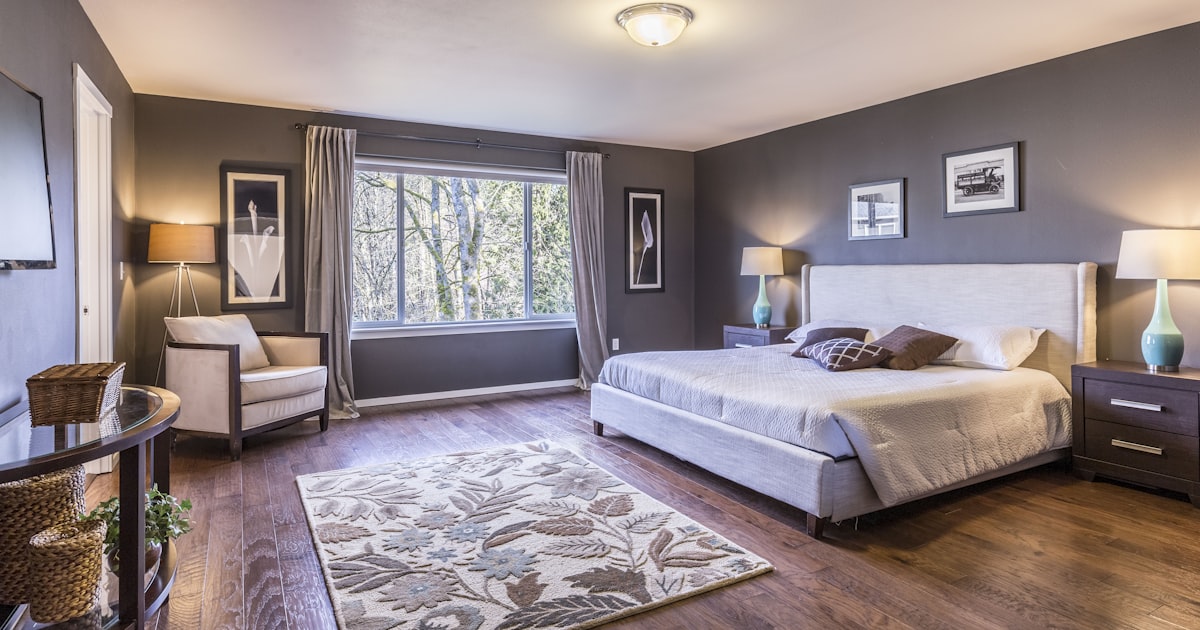
Your bedroom layout affects how you sleep more than your decor does. The single most important decision is where the bed sits, called the command position: a solid wall behind the headboard, a clear view of the door, not lined up with the doorway. Get that right first, then handle doors, mirrors and what does not belong in the room.
Why Your Bedroom Layout Matters More Than Your Decor
Here is something most people get wrong: they think a bedroom feels good because of the right paint color or the right throw pillows. Those things matter, sure. But they are surface-level fixes. The layout of your room, where your bed sits, what you see when you wake up, how movement flows through the space, that is what actually determines how a room makes you feel.
Think about it this way. You have probably walked into a restaurant and immediately felt comfortable, without being able to explain why. Or you have sat down at a table and felt exposed or uneasy. That instinct is real. It comes from your brain processing spatial information: where the walls are, where the door is, whether your back is protected or not.
Your bedroom works the same way. Every night, your subconscious is scanning the room while you try to fall asleep. If something about the arrangement triggers a low-level alert, even one you are not consciously aware of, your sleep suffers.
Start With Your Bed
The bed is the most important thing in the room. Everything else revolves around it. So getting the bed right is step one.
The ideal position for your bed is what feng shui calls the command position. Here is the short version: your headboard should be against a solid wall, you should be able to see the bedroom door from where you lie, and you should not be directly in line with the door. That is it. Back to a wall, door in view, not in the direct path of the doorway.
Why does this work? Because your brain wants to feel protected from behind and aware of what is coming from the front. When your back is exposed or you cannot see the entrance, your nervous system stays a little bit activated. Not enough that you notice, but enough that it chips away at sleep quality over time.
If your room makes this position impossible, do not panic. Not every bedroom allows for a textbook setup. The goal is to get as close as you can. For a deeper look at every possible bed arrangement and what to do when your room is tricky, check out our complete guide to bed placement.
Bed placement is the biggest single lever in a bedroom, and it has more nuance than fits here. See the complete guide to bed placement for how to handle beams, windows and rooms that will not give you a textbook setup.
Doors, Windows, and Mirrors
Once your bed is placed, the next thing to consider is what surrounds it.
Doors. If your bedroom has multiple doors (closet, bathroom, balcony), that creates a lot of visual openings. Each one pulls a little bit of your attention, even when they are closed. The fix is simple: keep non-essential doors shut, especially at night. If you have a closet with mirrored sliding doors, that counts double, because the mirror acts like another opening. More on that in a second.
Windows. A window behind your headboard is not ideal. It creates a sense of openness right where you want solidity. If that is your only option, use a thick headboard or heavy curtains to create a visual barrier. A window across from you or to the side is fine and actually good for air circulation.
Mirrors. This is one of the most common bedroom feng shui questions, and the answer is straightforward. Mirrors reflect movement and light, which is great in a living room but counterproductive in a space designed for rest. The most important rule: do not have a mirror where you can see your own reflection from the bed. If you have mirrored closet doors you cannot remove, covering them at night with a curtain or repositioning furniture so the reflection does not hit the bed directly makes a real difference.
What Belongs in Your Bedroom (And What Does Not)
A bedroom should be the calmest room in your home. That sounds obvious, but look around yours right now. Chances are there is a desk, a TV, workout equipment, or a pile of laundry competing for attention.
In feng shui terms, the bedroom should lean heavily toward yin, which just means calm, quiet, and restful. Things that bring active or stimulating energy (desks, screens, exercise gear) pull the room in the opposite direction. If you have to work from your bedroom, at least create a clear boundary between the work zone and the sleep zone. A screen, a bookshelf, or even just turning the desk chair away from the bed helps your brain switch modes at night.
A few other things worth keeping in mind: avoid heavy objects hanging above your bed (shelves, big frames, ceiling fans). Anything that feels like it could fall on you, even subconsciously, is going to make you less relaxed. Stick to light textures and calm colors near the bed. And keep things tidy under the bed. Storage under there is fine, but stuffing it until things are jammed in creates stagnant energy that is more about clutter psychology than anything mystical.
Five Things You Can Do Today
You do not need to redesign your entire room to see a difference. Start here:
Check your bed position. Can you see the door from where you sleep? Is your headboard against a solid wall? If not, see if there is a better spot.
Close the extra doors. Closet doors, bathroom doors, balcony doors. Shut them all before bed.
Move or cover mirrors. If you can see yourself from the bed, drape something over the mirror or angle it away.
Clear the nightstands. Keep them clean, symmetrical, and free of clutter. Matching lamps or tables on both sides of the bed creates visual balance.
Remove one thing that does not belong. The exercise bike, the stack of work papers, the laundry chair. Pick one and get it out of the sleep zone.
The Same Principle Works in Every Room
Everything above is written for the bedroom, but the underlying rule, a solid wall behind you, a clear view of the entrance, is not specific to sleep. It works the same way for a couch, a desk, or a dining chair. If a room in your home feels slightly off and you cannot say why, check whether whoever sits there most often has their back to an open doorway. That single detail explains more uncomfortable rooms than bad paint or the wrong furniture ever does.
But Here Is the Thing
General principles get you 80% of the way there. But every room is different. The shape of your space, where the door is, how many windows you have, whether you are dealing with a beam or a sloped ceiling, all of that changes what the "right" layout looks like for you specifically.
That is why reading about bedroom feng shui only goes so far. At some point, you need to look at your actual room and figure out what works for that specific space. If you are working with a small bedroom, the priorities shift. If sleep problems brought you here, certain fixes matter more than others. And if you are a renter who cannot renovate, the whole game is about making the best of what you have got.
See this for your own address
The room is only half of it. The direction your house faces changes which side of your bedroom the year's chart lands on. Enter your address to see yours, free.
Frequently asked questions
Does bedroom feng shui actually change how I sleep?
The layout changes are the ones with a plausible mechanism behind them. A bed you can see the door from, a solid wall behind your head, and less light and movement in your sightline all reduce the small alerting signals your brain keeps processing after you close your eyes. Colors and ornaments are the decorative end of feng shui and are much less likely to change anything you would notice.
What is the single most important thing to get right in a bedroom?
Where the bed sits. Every other bedroom rule is smaller than this one. Put the bed where you can see the door without lying directly in line with it, and where the wall behind the headboard is solid rather than a window. If you only change one thing, change that.
Do I need to buy anything to improve my bedroom?
No. Almost everything that makes a bedroom feel wrong is a position problem, and positions move for free. Moving the bed, turning a mirror, and taking work out of the room cost nothing. Treat any advice that opens with a shopping list with suspicion.
Does it matter which way my head points when I sleep?
It matters less than where the bed sits in the room, and it only has a personal answer. The direction that suits you comes from your Kua number, which is worked out from your birth date, so there is no single best direction that applies to everyone. Get the bed position right first, then use head direction as a refinement.
What if my room only has one workable wall?
Then that wall is the answer and you stop looking for a better one. Small rooms and awkward rooms often have exactly one arrangement that works, and forcing a textbook layout into a room that cannot hold it makes the room worse. Take the best available position and fix the smaller things around it.